

gpOptimizer: Single-Task Acquisition Functions#
#!pip install gpcam==8.4.0
#!pip install matplotlib
Setup#
import numpy as np
import matplotlib.pyplot as plt
from gpcam import GPOptimizer
import time
from loguru import logger
from distributed import Client
client = Client()


%load_ext autoreload
%autoreload 2
from itertools import product
x_pred1D = np.linspace(0,1,1000).reshape(-1,1)
Data Preparation#
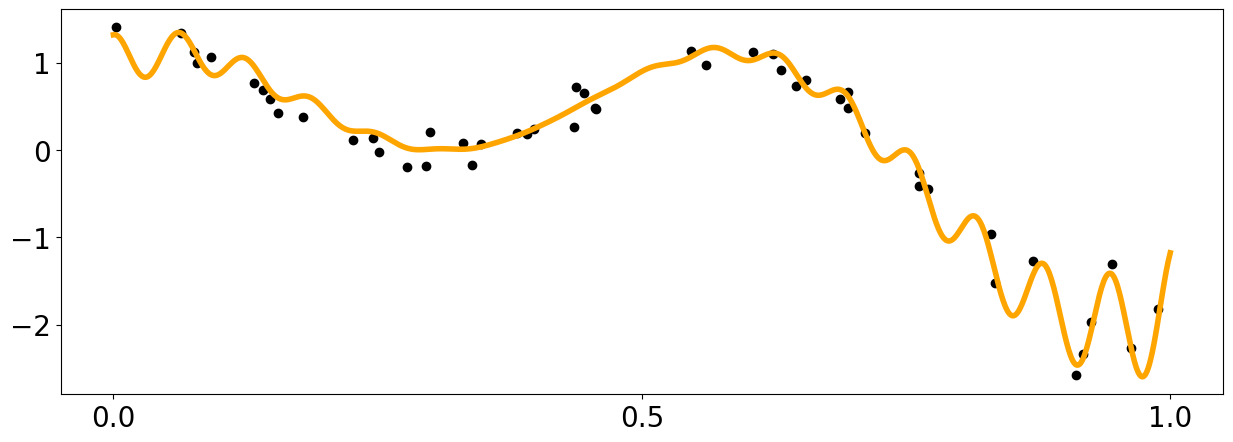
x = np.linspace(0,600,1000)
def f1(x):
    return np.sin(5. * x) + np.cos(10. * x) + (2.* (x-0.4)**2) * np.cos(100. * x)

x_data = np.random.rand(50).reshape(-1,1)
y_data = f1(x_data[:,0]) + (np.random.rand(len(x_data))-0.5) * 0.5

plt.figure(figsize = (15,5))
plt.xticks([0.,0.5,1.0])
plt.yticks([-2,-1,0.,1])
plt.xticks(fontsize=20)
plt.yticks(fontsize=20)
plt.plot(x_pred1D,f1(x_pred1D), color = 'orange', linewidth = 4)
plt.scatter(x_data[:,0],y_data, color = 'black')
<matplotlib.collections.PathCollection at 0x7f329c192090>
Customizing the Gaussian Process#
def my_noise(x,hps):
    #This is a simple noise function but can be made arbitrarily complex using many hyperparameters.
    #The noise function can return a matrix or a vector
    return np.zeros((len(x))) + hps[2]

#stationary
from gpcam.kernels import *
def skernel(x1,x2,hps):
    #The kernel follows the mathematical definition of a kernel. This
    #means there is no limit to the variety of kernels you can define.
    d = get_distance_matrix(x1,x2)
    return hps[0] * matern_kernel_diff1(d,hps[1])


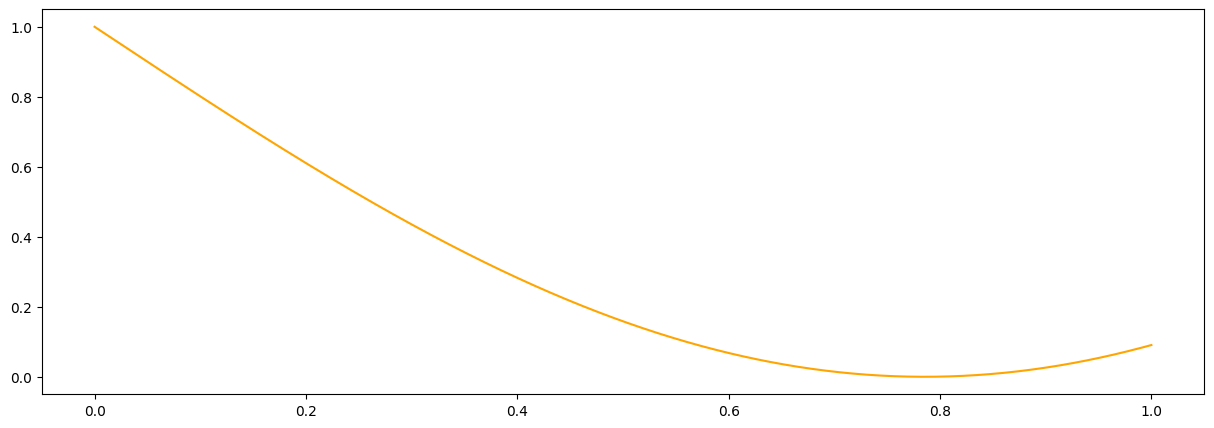
def meanf(x, hps):
    #This is a simple mean function but it can be arbitrarily complex using many hyperparameters.
    return 1.-np.sin(hps[3] * x[:,0])
#it is a good idea to plot the prior mean function to make sure we did not mess up
plt.figure(figsize = (15,5))
plt.plot(x_pred1D,meanf(x_pred1D, np.array([1.,1.,5.0,2.])), color = 'orange', label = 'task1')
[<matplotlib.lines.Line2D at 0x7f327d613e90>]
Initialization and Different Training Options#
my_gpo = GPOptimizer(x_data,y_data,
            init_hyperparameters = np.ones((4))/10.,  # We need enough of those for kernel, noise, and prior mean functions
            compute_device='cpu',
            kernel_function=skernel,
            kernel_function_grad=None,
            prior_mean_function=meanf,
            prior_mean_function_grad=None,
            noise_function=my_noise,
            #noise_variances=np.zeros(y_data.shape) + 0.1,
            gp2Scale = False,
            ram_economy=False,
            args={'a': 1.5, 'b':2.},
            )

hps_bounds = np.array([[0.01,10.], #signal variance for the kernel
                       [0.01,10.], #length scale for the kernel
                       [0.00001,0.1],  #noise
                       [0.00001,1.]  #mean
                      ])

#the following is not needed, this is just to show how data is replced or appended
x_update = np.array([0.1,0.2,0.5]).reshape(3,1)
y_update = f1(x_update[:,0]) + (np.random.rand(len(x_update))-0.5) * 0.5
my_gpo.tell(x_update, y_update, append=True) ##append to the data
my_gpo.tell(x_data, y_data, append=False) ## back to normal overwriting the updated data

st = time.time()
print("Standard Training (MCMC)")
hps = my_gpo.train(hyperparameter_bounds=hps_bounds, info = True, max_iter = 100)
print("Result=", hps, "after ", time.time() - st, " seconds")
print("")

print("ADAM")
hps = my_gpo.train(hyperparameter_bounds=hps_bounds, info = True, max_iter = 100, method="adam")
print("Result=", hps, "after ", time.time() - st, " seconds")
print("")

print("Global Training")
my_gpo.train(hyperparameter_bounds=hps_bounds, method='global', max_iter = 20)
print("Result=", hps, "after ", time.time() - st, " seconds")
print("")

print("Local Training")
my_gpo.train(hyperparameter_bounds=hps_bounds, method='local')
print("Result=", hps, "after ", time.time() - st, " seconds")
print("")

print("HGDL Training")
my_gpo.train(hyperparameter_bounds=hps_bounds, method='hgdl', max_iter=2, dask_client=client)
print("Result=", hps, "after ", time.time() - st, " seconds")
print("")
Standard Training (MCMC)
Starting likelihood. f(x)=  -57.45359939750017
Finished  10  out of  100  iterations. f(x)=  -57.45359939750017
Finished  20  out of  100  iterations. f(x)=  -57.45359939750017
Finished  30  out of  100  iterations. f(x)=  -22.700249071580544
Finished  40  out of  100  iterations. f(x)=  -18.638280971306042
Finished  50  out of  100  iterations. f(x)=  -19.052535503071805
Finished  60  out of  100  iterations. f(x)=  -16.64788686268859
Finished  70  out of  100  iterations. f(x)=  -16.66045939452155
Finished  80  out of  100  iterations. f(x)=  -15.16518351381081
Finished  90  out of  100  iterations. f(x)=  -15.414557536356075
Result= [1.68898969 0.36754555 0.07665019 0.02754226] after  0.04072451591491699  seconds

ADAM
Result= [1.99519374 0.38528064 0.04630458 0.86115948] after  0.13742733001708984  seconds

Global Training
Result= [1.99519374 0.38528064 0.04630458 0.86115948] after  0.4720752239227295  seconds

Local Training
Result= [1.99519374 0.38528064 0.04630458 0.86115948] after  0.47588443756103516  seconds

HGDL Training
Result= [1.99519374 0.38528064 0.04630458 0.86115948] after  1.300339937210083  seconds
Asynchronous Training#
Train asynchronously – via Adam, HGDL, or MCMC – on a remote server or locally. You can also start a bunch of different training runs on different computers. This training will continue without any signs of life until you query the solution via ‘update_hyperparameters(object)’ or call ‘my_gpo.stop_training(opt_obj)’
HGDL#
my_gpo.set_hyperparameters(np.ones((4))/10.)
opt_obj = my_gpo.train(hyperparameter_bounds=hps_bounds, dask_client=client, asynchronous=True, method="hgdl")
print(my_gpo.hyperparameters)
for i in range(20):
    my_gpo.update_hyperparameters(opt_obj)
    print("iteration ", i, " : ",my_gpo.hyperparameters)
    time.sleep(0.1)
my_gpo.stop_training(opt_obj) ##this leaves the dask client alive, kill_client() will shut it down.
[0.1 0.1 0.1 0.1]
iteration  0  :  [0.1 0.1 0.1 0.1]
iteration  1  :  [1.58964583 0.35133771 0.0463426  1.        ]
/home/marcus/Coding/fvGP/fvgp/gp.py:881: UserWarning: Hyperparameter update not successful len(optima list) = 0
  hps = self.trainer.update_hyperparameters(opt_obj)
iteration  2  :  [1.58964583 0.35133771 0.0463426  1.        ]
iteration  3  :  [1.58964583 0.35133771 0.0463426  1.        ]
iteration  4  :  [1.58964583 0.35133771 0.0463426  1.        ]
iteration  5  :  [1.58964583 0.35133771 0.0463426  1.        ]
iteration  6  :  [1.58964583 0.35133771 0.0463426  1.        ]
iteration  7  :  [1.58964583 0.35133771 0.0463426  1.        ]
iteration  8  :  [1.58964583 0.35133771 0.0463426  1.        ]
iteration  9  :  [1.58964583 0.35133771 0.0463426  1.        ]
iteration  10  :  [1.58964583 0.35133771 0.0463426  1.        ]
iteration  11  :  [1.58964583 0.35133771 0.0463426  1.        ]
iteration  12  :  [1.58964583 0.35133771 0.0463426  1.        ]
iteration  13  :  [1.58964583 0.35133771 0.0463426  1.        ]
iteration  14  :  [1.58964583 0.35133771 0.0463426  1.        ]
iteration  15  :  [1.58964583 0.35133771 0.0463426  1.        ]
iteration  16  :  [1.58964583 0.35133771 0.0463426  1.        ]
iteration  17  :  [1.58964583 0.35133771 0.0463426  1.        ]
iteration  18  :  [1.58964583 0.35133771 0.0463426  1.        ]
iteration  19  :  [1.58964583 0.35133771 0.0463426  1.        ]
ADAM#
my_gpo.set_hyperparameters(np.array([1.,1.,1.,1.]))
print(my_gpo.hyperparameters)
opt_obj = my_gpo.train(hyperparameter_bounds=hps_bounds, dask_client=client, asynchronous=True, method='adam')
# The result won't change much (or at all) since this is such a simple optimization
for i in range(20):
    my_gpo.update_hyperparameters(opt_obj)
    print("iteration ", i, " : ",my_gpo.hyperparameters)
    time.sleep(0.1)
my_gpo.stop_training(opt_obj) ##this leaves the dask client alive, kill_client() will shut it down.
[1. 1. 1. 1.]
iteration  0  :  [8.18982648 9.10473692 0.05892872 0.14106267]
iteration  1  :  [8.77385382 8.51139661 0.34629171 0.81652448]
iteration  2  :  [9.15980363 8.04148331 0.42356338 0.91935441]
iteration  3  :  [9.53612743 7.52049452 0.46979084 0.9178787 ]
iteration  4  :  [9.89090397 6.96833202 0.49523519 0.90090135]
iteration  5  :  [10.31926567  6.21066282  0.50912542  0.86887424]
iteration  6  :  [10.81752773  5.18678682  0.50720787  0.82268905]
iteration  7  :  [11.52099983  3.49057575  0.47492533  0.77255324]
iteration  8  :  [12.4685126   0.69733624  0.24422075  0.8679103 ]
iteration  9  :  [12.20727962  0.77255015  0.0463097   0.97412546]
iteration  10  :  [11.90286014  0.76586561  0.04681552  1.07606152]
iteration  11  :  [11.56083602  0.75794917  0.04681097  1.17149964]
iteration  12  :  [11.18136305  0.74887599  0.04680381  1.25706446]
iteration  13  :  [10.77359909  0.73881135  0.0467952   1.3289291 ]
iteration  14  :  [10.34198007  0.72782024  0.04678567  1.38642828]
iteration  15  :  [9.86324784 0.71522791 0.04677497 1.43259195]
iteration  16  :  [9.33667396 0.70087426 0.04676315 1.46727396]
iteration  17  :  [8.77404513 0.68491594 0.04675035 1.49101978]
iteration  18  :  [8.15384692 0.66650493 0.04673571 1.50640015]
iteration  19  :  [7.4745217  0.64522308 0.04671854 1.51490218]
MCMC#
my_gpo.set_hyperparameters(np.array([1.,1.,1.,1.]))
print(my_gpo.hyperparameters)
opt_obj = my_gpo.train(hyperparameter_bounds=hps_bounds, dask_client=client, asynchronous=True, method='mcmc')
# The result won't change much (or at all) since this is such a simple optimization
for i in range(20):
    my_gpo.update_hyperparameters(opt_obj)
    print("iteration ", i, " : ",my_gpo.hyperparameters)
    time.sleep(0.1)
my_gpo.stop_training(opt_obj) ##this leaves the dask client alive, kill_client() will shut it down.
[1. 1. 1. 1.]
iteration  0  :  [1. 1. 1. 1.]
iteration  1  :  [4.29020852 0.52215149 0.04951336 0.84548404]
iteration  2  :  [3.87184689 0.38126789 0.04917364 0.79921262]
iteration  3  :  [4.20315227 0.61810961 0.05407959 0.79052919]
iteration  4  :  [5.04179296 0.61164863 0.04101402 0.51311478]
iteration  5  :  [6.64855494 0.63610798 0.03659832 0.07039344]
iteration  6  :  [5.92080706 0.56959858 0.04098325 0.14807541]
iteration  7  :  [3.98004501 0.52633057 0.03790581 0.81188697]
iteration  8  :  [5.15165494 0.46787565 0.04043386 0.58640984]
iteration  9  :  [4.52853608 0.72597793 0.06039227 0.40916232]
iteration  10  :  [2.60594224 0.44943824 0.05409285 0.66368617]
iteration  11  :  [7.41323269 0.86061831 0.04976672 0.11716609]
iteration  12  :  [4.71188782 0.56203315 0.042081   0.40070252]
iteration  13  :  [3.53262614 0.46961484 0.05058613 0.68431976]
iteration  14  :  [2.15225919 0.33381461 0.05561555 0.94886426]
iteration  15  :  [1.02067381 0.24300803 0.05752397 0.96274661]
iteration  16  :  [1.21308594 0.34185284 0.06570075 0.86006406]
iteration  17  :  [2.72030551 0.46295341 0.06399514 0.7718477 ]
iteration  18  :  [2.14410773 0.36908653 0.08491103 0.47272333]
iteration  19  :  [1.49939774 0.33391577 0.07033396 0.60716589]
Vizualizing the Results#
#let's make a prediction
x_pred = np.linspace(0,1,1000)
hps = my_gpo.train(hyperparameter_bounds=hps_bounds, info = False)

# different ways to call
var1 =  my_gpo.posterior_covariance(x_pred.reshape(-1,1), variance_only=False, add_noise=False)["v(x)"]
var1 =  my_gpo.posterior_covariance(x_pred.reshape(-1,1), variance_only=False, add_noise=True)["v(x)"]

mean1 = my_gpo.posterior_mean(x_pred.reshape(-1,1))["m(x)"]
var1 =  my_gpo.posterior_covariance(x_pred.reshape(-1,1), variance_only=False, add_noise=True)["v(x)"]
mean_grad = my_gpo.posterior_mean_grad(x_pred.reshape(-1,1), direction=0)["dm/dx"]

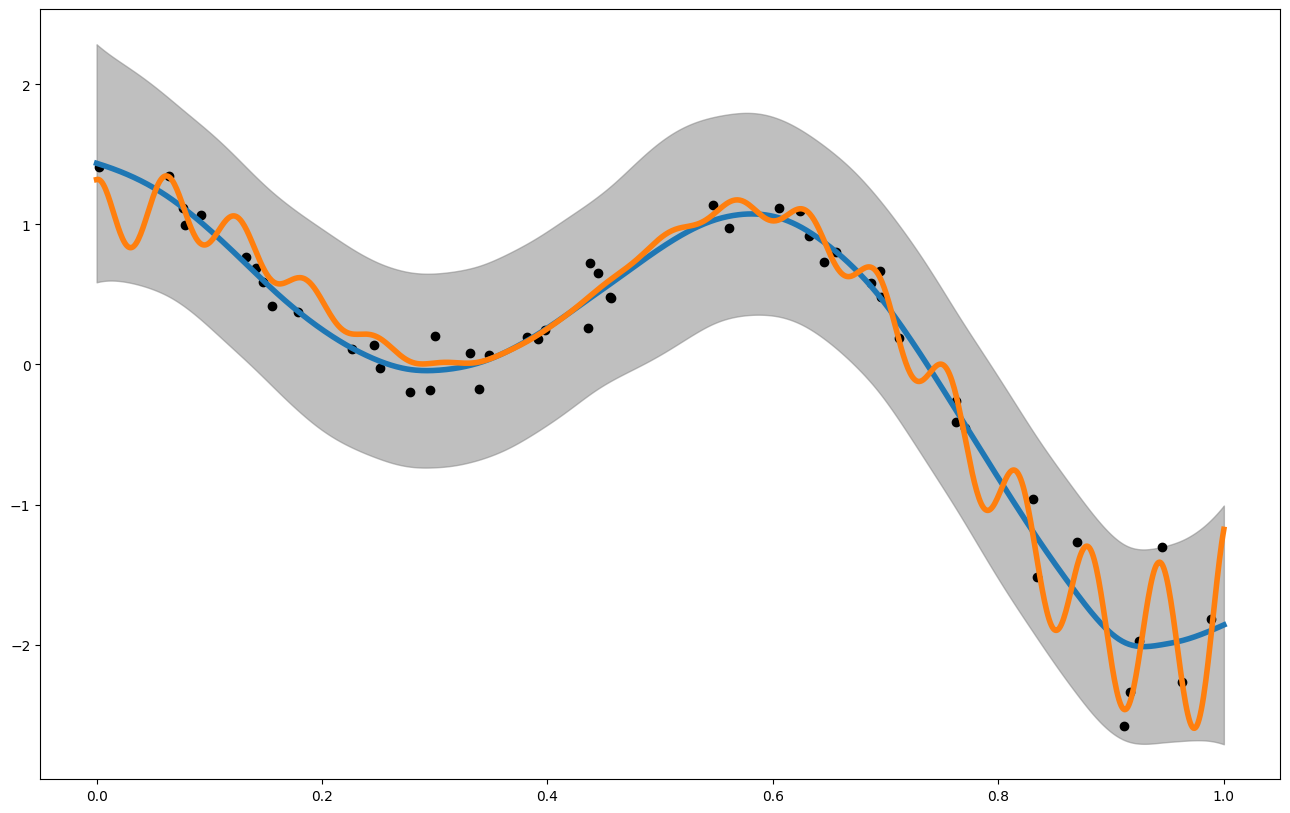
print("Posterior Mean and Uncertainty")
plt.figure(figsize = (16,10))
plt.plot(x_pred,mean1, label = "posterior mean", linewidth = 4)
plt.plot(x_pred1D,f1(x_pred1D), label = "latent function", linewidth = 4)
plt.fill_between(x_pred, mean1 - 3. * np.sqrt(var1), mean1 + 3. * np.sqrt(var1), alpha = 0.5, color = "grey", label = "var")
plt.scatter(my_gpo.x_data,my_gpo.y_data, color = 'black')
plt.show()

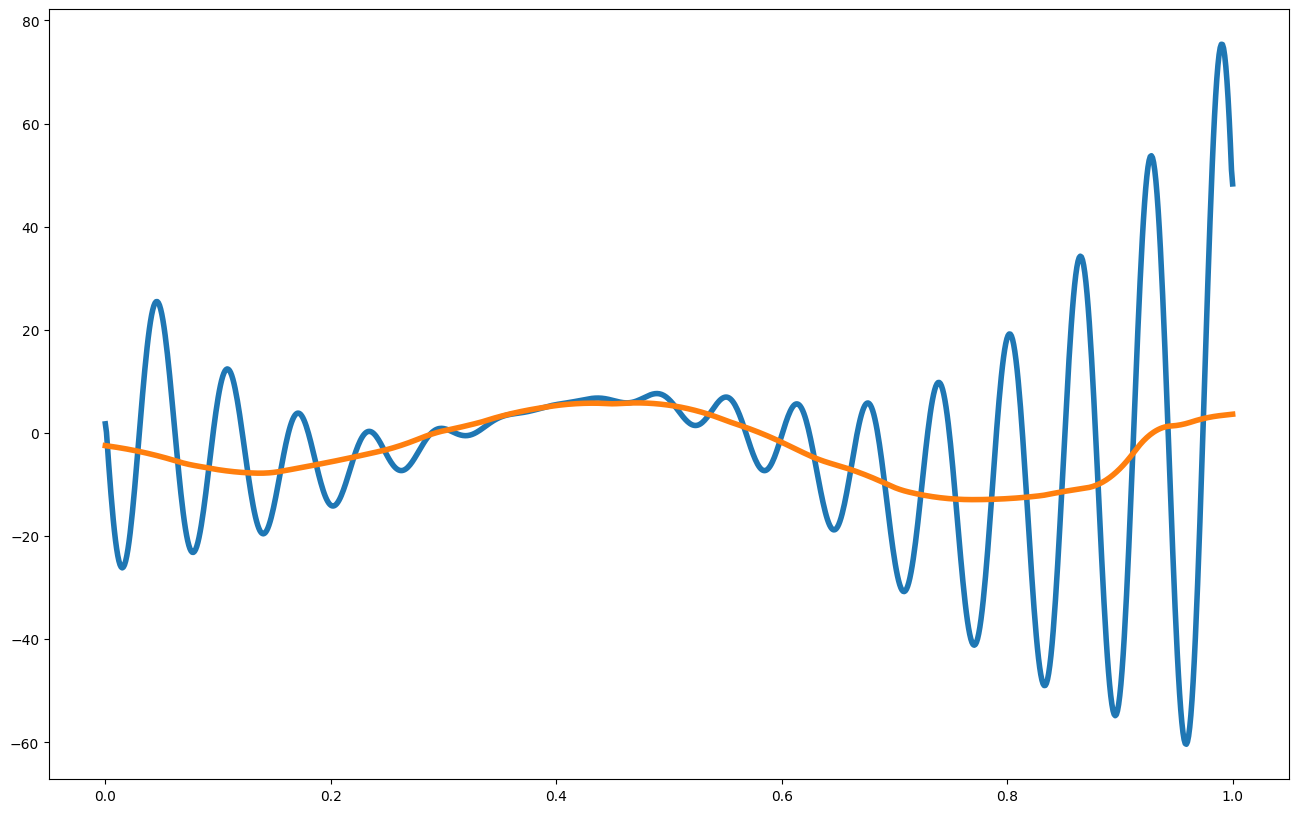
print("Posterior Mean Gradient")
plt.figure(figsize = (16,10))
dx = 1./len(x_pred)
plt.plot(x_pred1D,np.gradient(f1(x_pred1D).flatten(), dx), label = "ground truth gradient", linewidth = 4)
plt.plot(x_pred1D,mean_grad, label = "posterior mean grad", linewidth = 4)
plt.show()


##looking at some validation metrics
print("RMSE:             ",my_gpo.rmse(x_pred1D,f1(x_pred1D).flatten()))
print("NRMSE:            ",my_gpo.nrmse(x_pred1D,f1(x_pred1D).flatten()))
print("CRPS (mean, std): ",my_gpo.crps(x_pred1D,f1(x_pred1D).flatten()))
print("R2:               ",my_gpo.r2(x_pred1D,f1(x_pred1D).flatten()))
print("NLPD:             ",my_gpo.nlpd(x_pred1D,f1(x_pred1D).flatten()))
print("MSLL:             ",my_gpo.msll(x_pred1D,f1(x_pred1D).flatten()))
print("MAPE:             ",my_gpo.mape(x_pred1D,f1(x_pred1D).flatten()))
print("INTERVAL SCORE:   ",my_gpo.interval_score(x_pred1D,f1(x_pred1D).flatten()))
print("MPIW:             ",my_gpo.mpiw(x_pred1D))
print("PICP:             ",my_gpo.picp(x_pred1D,f1(x_pred1D).flatten()))
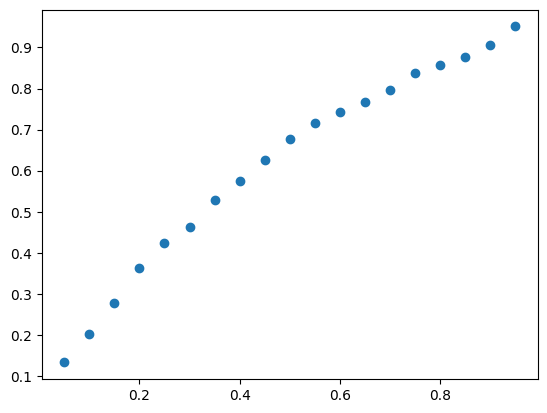
print("Coverage Curve:")
cov_curve = my_gpo.coverage_curve(x_pred1D,f1(x_pred1D).flatten())
plt.scatter(cov_curve["target_coverage"], cov_curve["measured_coverage"])
plt.show()

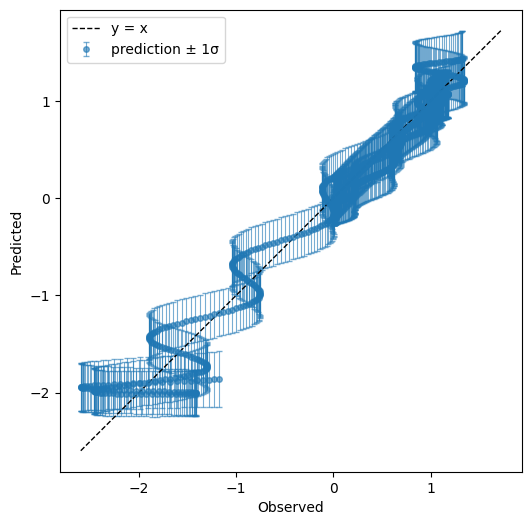
print("predicted vs. observed")
my_gpo.plot_observed_vs_predicted(x_pred1D,f1(x_pred1D).flatten())
Posterior Mean and Uncertainty
Posterior Mean Gradient
RMSE:              0.20773325650420307
NRMSE:             0.05267198239179237
CRPS (mean, std):  (np.float64(0.11518355308115732), np.float64(0.12482752059068643))
R2:                0.9594676277137122
NLPD:              0.4367242211316339
MSLL:              -1.0148770461937344
MAPE:              1.1468766010435933
INTERVAL SCORE:    1.0647691954820597
MPIW:              0.9303924244781772
PICP:              0.951
Coverage Curve:
predicted vs. observed
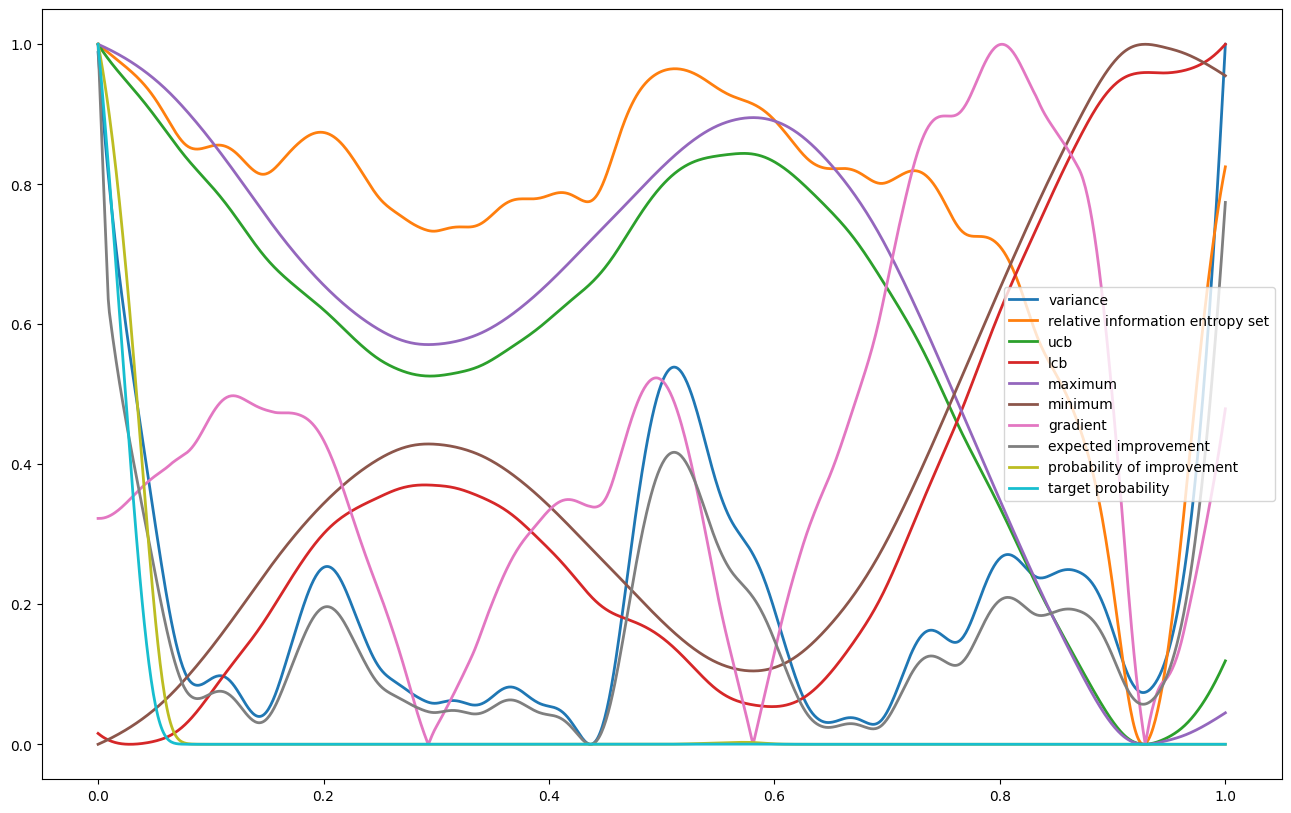
#available acquisition function for the single-task case:
acquisition_functions = ["variance","relative information entropy","relative information entropy set",
                        "ucb","lcb","maximum","minimum","gradient","expected improvement",
                         "probability of improvement", "target probability", "total correlation"]
plt.figure(figsize=(16,10))
for acq_func in acquisition_functions:
    print("Acquisition function ",acq_func)
    res = my_gpo.evaluate_acquisition_function(x_pred, acquisition_function=acq_func)
    if len(res)==len(x_pred):
        res = res - np.min(res)
        res = res/np.max(res)
        plt.plot(x_pred,res, label = acq_func, linewidth = 2)
    else: print("Some acquisition function return a scalar score for the entirety of points. Here: ", acq_func)
plt.legend()
plt.show()
Acquisition function  variance
Acquisition function  relative information entropy
Some acquisition function return a scalar score for the entirety of points. Here:  relative information entropy
Acquisition function  relative information entropy set
Acquisition function  ucb
Acquisition function  lcb
Acquisition function  maximum
Acquisition function  minimum
Acquisition function  gradient
Acquisition function  expected improvement
Acquisition function  probability of improvement
Acquisition function  target probability
Acquisition function  total correlation
Some acquisition function return a scalar score for the entirety of points. Here:  total correlation
ask()ing for Optimal Evaluations#
with several optimization methods and acquisition functions
#let's test the asks:
bounds = np.array([[0.0,1.0]])
for acq_func in acquisition_functions:
    for method in ["global","local","hgdl"]:
        print("Acquisition function ", acq_func," and method ",method)
        new_suggestion = my_gpo.ask(bounds, acquisition_function=acq_func,
                                    method=method, max_iter = 2, dask_client=client)
        print("led to new suggestion: \n", new_suggestion)
        print("")
Acquisition function  variance  and method  global
led to new suggestion:
 {'x': array([[0.99857729]]), 'f_a(x)': array([0.18439853]), 'opt_obj': None}

Acquisition function  variance  and method  local
led to new suggestion:
 {'x': array([[0.17045543]]), 'f_a(x)': array([0.0987701]), 'opt_obj': None}

Acquisition function  variance  and method  hgdl
led to new suggestion:
 {'x': array([[1.]]), 'f_a(x)': array([0.18890567]), 'opt_obj': <hgdl.hgdl.HGDL object at 0x7f327c6602d0>}

Acquisition function  relative information entropy  and method  global
led to new suggestion:
 {'x': array([[0.0015928]]), 'f_a(x)': array([-32.45496285]), 'opt_obj': None}

Acquisition function  relative information entropy  and method  local
led to new suggestion:
 {'x': array([[1.]]), 'f_a(x)': array([-138.3052145]), 'opt_obj': None}

Acquisition function  relative information entropy  and method  hgdl
led to new suggestion:
 {'x': array([[0.]]), 'f_a(x)': array([-31.19240075]), 'opt_obj': <hgdl.hgdl.HGDL object at 0x7f327d567310>}

Acquisition function  relative information entropy set  and method  global
led to new suggestion:
 {'x': array([[0.00045886]]), 'f_a(x)': array([-31.55481133]), 'opt_obj': None}

Acquisition function  relative information entropy set  and method  local
led to new suggestion:
 {'x': array([[0.]]), 'f_a(x)': array([-31.19240075]), 'opt_obj': None}

Acquisition function  relative information entropy set  and method  hgdl
/home/marcus/Coding/gpCAM/gpcam/gp_optimizer_base.py:528: UserWarning: I set vectorized=False for total corr. or rel. inf. entropy.
  warnings.warn("I set vectorized=False for total corr. or rel. inf. entropy.")
led to new suggestion:
 {'x': array([[0.]]), 'f_a(x)': array([-31.19240075]), 'opt_obj': <hgdl.hgdl.HGDL object at 0x7f325e629010>}

Acquisition function  ucb  and method  global
led to new suggestion:
 {'x': array([[0.01172727]]), 'f_a(x)': array([1.89992718]), 'opt_obj': None}

Acquisition function  ucb  and method  local
led to new suggestion:
 {'x': array([[0.]]), 'f_a(x)': array([1.99938938]), 'opt_obj': None}

Acquisition function  ucb  and method  hgdl
led to new suggestion:
 {'x': array([[0.]]), 'f_a(x)': array([1.99938938]), 'opt_obj': <hgdl.hgdl.HGDL object at 0x7f325e6e3910>}

Acquisition function  lcb  and method  global
led to new suggestion:
 {'x': array([[0.99424508]]), 'f_a(x)': array([2.39366679]), 'opt_obj': None}

Acquisition function  lcb  and method  local
led to new suggestion:
 {'x': array([[1.]]), 'f_a(x)': array([2.42600288]), 'opt_obj': None}

Acquisition function  lcb  and method  hgdl
led to new suggestion:
 {'x': array([[1.]]), 'f_a(x)': array([2.42600288]), 'opt_obj': <hgdl.hgdl.HGDL object at 0x7f325e56a190>}

Acquisition function  maximum  and method  global
led to new suggestion:
 {'x': array([[0.00125045]]), 'f_a(x)': array([1.43323997]), 'opt_obj': None}

Acquisition function  maximum  and method  local
led to new suggestion:
 {'x': array([[0.57817127]]), 'f_a(x)': array([1.07452761]), 'opt_obj': None}

Acquisition function  maximum  and method  hgdl
led to new suggestion:
 {'x': array([[0.]]), 'f_a(x)': array([1.43634098]), 'opt_obj': <hgdl.hgdl.HGDL object at 0x7f3308620090>}

Acquisition function  minimum  and method  global
led to new suggestion:
 {'x': array([[0.9251833]]), 'f_a(x)': array([2.0131075]), 'opt_obj': None}

Acquisition function  minimum  and method  local
led to new suggestion:
 {'x': array([[0.89100372]]), 'f_a(x)': array([1.84875613]), 'opt_obj': None}

Acquisition function  minimum  and method  hgdl
led to new suggestion:
 {'x': array([[0.29293917]]), 'f_a(x)': array([0.0439668]), 'opt_obj': <hgdl.hgdl.HGDL object at 0x7f325e483350>}

Acquisition function  gradient  and method  global
led to new suggestion:
 {'x': array([[0.80323276]]), 'f_a(x)': array([1.42968872]), 'opt_obj': None}

Acquisition function  gradient  and method  local
led to new suggestion:
 {'x': array([[0.85976807]]), 'f_a(x)': array([1.21707289]), 'opt_obj': None}

Acquisition function  gradient  and method  hgdl
led to new suggestion:
 {'x': array([[0.80182216]]), 'f_a(x)': array([1.43003972]), 'opt_obj': <hgdl.hgdl.HGDL object at 0x7f325e723cd0>}

Acquisition function  expected improvement  and method  global
led to new suggestion:
 {'x': array([[0.00400583]]), 'f_a(x)': array([0.07859944]), 'opt_obj': None}

Acquisition function  expected improvement  and method  local
led to new suggestion:
 {'x': array([[0.69696532]]), 'f_a(x)': array([0.03527807]), 'opt_obj': None}

Acquisition function  expected improvement  and method  hgdl
led to new suggestion:
 {'x': array([[0.]]), 'f_a(x)': array([0.08752918]), 'opt_obj': <hgdl.hgdl.HGDL object at 0x7f325e52e0d0>}

Acquisition function  probability of improvement  and method  global
led to new suggestion:
 {'x': array([[0.00326151]]), 'f_a(x)': array([0.5350753]), 'opt_obj': None}

Acquisition function  probability of improvement  and method  local
led to new suggestion:
 {'x': array([[0.77550789]]), 'f_a(x)': array([1.07779943e-76]), 'opt_obj': None}

Acquisition function  probability of improvement  and method  hgdl
led to new suggestion:
 {'x': array([[0.]]), 'f_a(x)': array([0.55104161]), 'opt_obj': <hgdl.hgdl.HGDL object at 0x7f325e1d6e90>}

Acquisition function  target probability  and method  global
led to new suggestion:
 {'x': array([[0.00299599]]), 'f_a(x)': array([0.34633048]), 'opt_obj': None}

Acquisition function  target probability  and method  local
led to new suggestion:
 {'x': array([[0.29110071]]), 'f_a(x)': array([0.]), 'opt_obj': None}

Acquisition function  target probability  and method  hgdl
led to new suggestion:
 {'x': array([[0.57053603]]), 'f_a(x)': array([9.87056945e-05]), 'opt_obj': <hgdl.hgdl.HGDL object at 0x7f325e125a10>}

Acquisition function  total correlation  and method  global
led to new suggestion:
 {'x': array([[0.50357293]]), 'f_a(x)': array([-3.24201436]), 'opt_obj': None}

Acquisition function  total correlation  and method  local
led to new suggestion:
 {'x': array([[1.]]), 'f_a(x)': array([-3.8723385]), 'opt_obj': None}

Acquisition function  total correlation  and method  hgdl
led to new suggestion:
 {'x': array([[0.50326358]]), 'f_a(x)': array([-3.24194903]), 'opt_obj': <hgdl.hgdl.HGDL object at 0x7f325e2c7c90>}
#here we can test other options of the ask() command
bounds = np.array([[0.0,1.0]])
new_suggestion = my_gpo.ask(bounds, acquisition_function="total_correlation", method="global",
                            max_iter=10, n = 5, info = True)
my_gpo.ask(bounds, n = 5, acquisition_function="variance", vectorized=True, method = 'global')
my_gpo.ask(bounds, n = 1, acquisition_function="relative information entropy", vectorized=True, method = 'global')
my_gpo.ask(bounds, n = 2, acquisition_function="expected improvement", vectorized=True, method = 'global')
my_gpo.ask(bounds, n = 1, acquisition_function="variance", vectorized=True, method = 'global')
my_gpo.ask(bounds, n = 3, acquisition_function="variance", vectorized=True, method = 'hgdl', dask_client=client)
print(new_suggestion)
differential_evolution step 1: f(x)= 21.87759314936121
differential_evolution step 2: f(x)= 21.12037920781099
differential_evolution step 3: f(x)= 21.12037920781099
differential_evolution step 4: f(x)= 21.12037920781099
/home/marcus/Coding/gpCAM/gpcam/gp_optimizer_base.py:524: UserWarning: You specified n>1 and method != 'hgdl' in ask(). The acquisition function has therefore been changed to 'total correlation'.
  warnings.warn("You specified n>1 and method != 'hgdl' in ask(). The acquisition function "
differential_evolution step 5: f(x)= 20.439267912810713
differential_evolution step 6: f(x)= 20.439267912810713
differential_evolution step 7: f(x)= 20.328735289846882
differential_evolution step 8: f(x)= 20.328735289846882
differential_evolution step 9: f(x)= 20.328735289846882
differential_evolution step 10: f(x)= 20.328735289846882
{'x': array([[0.80066319],
       [0.79108331],
       [0.49353202],
       [0.53110291],
       [0.72713549]]), 'f_a(x)': array([-20.32873529]), 'opt_obj': None}
#we can evaluate the acqisiiton function on batches of candidates in parallel:
candidates = np.random.uniform(low = bounds[:,0], high=bounds[:,1], size = (30,1))
candidate_list = [entry for entry in candidates]
#ask sequentially
print("suggestions=", my_gpo.ask(candidate_list, n = 30, acquisition_function="variance", vectorized=False)["x"][0])
#ask in parallel on DASK workers, but sequentially on each worker:
print("suggestions=", my_gpo.ask(candidate_list, n = 30, acquisition_function="variance", vectorized=False, batch_size = 10, dask_client=client)["x"][0])
#ask in parallel on DASK workers, and vectorized (if possible) on each worker:
print("suggestions=", my_gpo.ask(candidate_list, n = 30, acquisition_function="variance", vectorized=True, batch_size = 10, dask_client=client)["x"][0])
#ask vectorized (if possible):
print("suggestions=", my_gpo.ask(candidate_list, n = 30, acquisition_function="variance", vectorized=True)["x"][0])
print("They should be the same!")
suggestions= [0.5118965]
suggestions= [0.5118965]
suggestions= [0.5118965]
suggestions= [0.5118965]
They should be the same!
bounds = np.array([[0.0,1.0]])

#You can even start an ask() search asynchronously and check back later what was found
new_suggestion = my_gpo.ask(bounds, acquisition_function=acquisition_functions[0], method="hgdlAsync", dask_client=client)
time.sleep(10)
print(new_suggestion)
new_suggestion["opt_obj"].kill_client()
{'x': array([[0.]]), 'f_a(x)': array([-0.]), 'opt_obj': <hgdl.hgdl.HGDL object at 0x7f325dc6e210>}
[{'x': array([0.]),
  'f(x)': np.float64(-0.18768280111824148),
  'classifier': 'degenerate',
  'Hessian eigvals': array([0.]),
  'df/dx': array([2.30888748]),
  '|df/dx|': np.float64(2.3088874782639657),
  'radius': np.float64(0.0)},
 {'x': array([0.5110164]),
  'f(x)': np.float64(-0.1407138191164292),
  'classifier': 'zero curvature',
  'Hessian eigvals': array([0.]),
  'df/dx': array([-0.00015813]),
  '|df/dx|': np.float64(0.0001581332287337034),
  'radius': np.float64(0.0)},
 {'x': array([0.20313894]),
  'f(x)': np.float64(-0.11094946537844927),
  'classifier': 'minimum',
  'Hessian eigvals': array([29.08706609]),
  'df/dx': array([-5.10327891e-07]),
  '|df/dx|': np.float64(5.10327891056761e-07),
  'radius': np.float64(0.034379541647070695)},
 {'x': array([0.86068642]),
  'f(x)': np.float64(-0.11049344113842001),
  'classifier': 'minimum',
  'Hessian eigvals': array([8.85820584]),
  'df/dx': array([-5.48616708e-07]),
  '|df/dx|': np.float64(5.486167076185211e-07),
  'radius': np.float64(0.11288967750000069)},
 {'x': array([0.3656675]),
  'f(x)': np.float64(-0.09296362356046356),
  'classifier': 'zero curvature',
  'Hessian eigvals': array([0.]),
  'df/dx': array([1.159145e-05]),
  '|df/dx|': np.float64(1.159145002205264e-05),
  'radius': np.float64(0.0)},
 {'x': array([0.36566666]),
  'f(x)': np.float64(-0.09296362355930513),
  'classifier': 'minimum',
  'Hessian eigvals': array([14.17341244]),
  'df/dx': array([-1.98244199e-07]),
  '|df/dx|': np.float64(1.9824419883462951e-07),
  'radius': np.float64(0.07055463911548977)}]